How to Build a Newsroom That Does Not Exist
Seventy fake outlets. Nearly nine thousand articles in twenty languages. One advertising agency in France. And in Malaysia, a platform that profiled voters in all 222 seats.
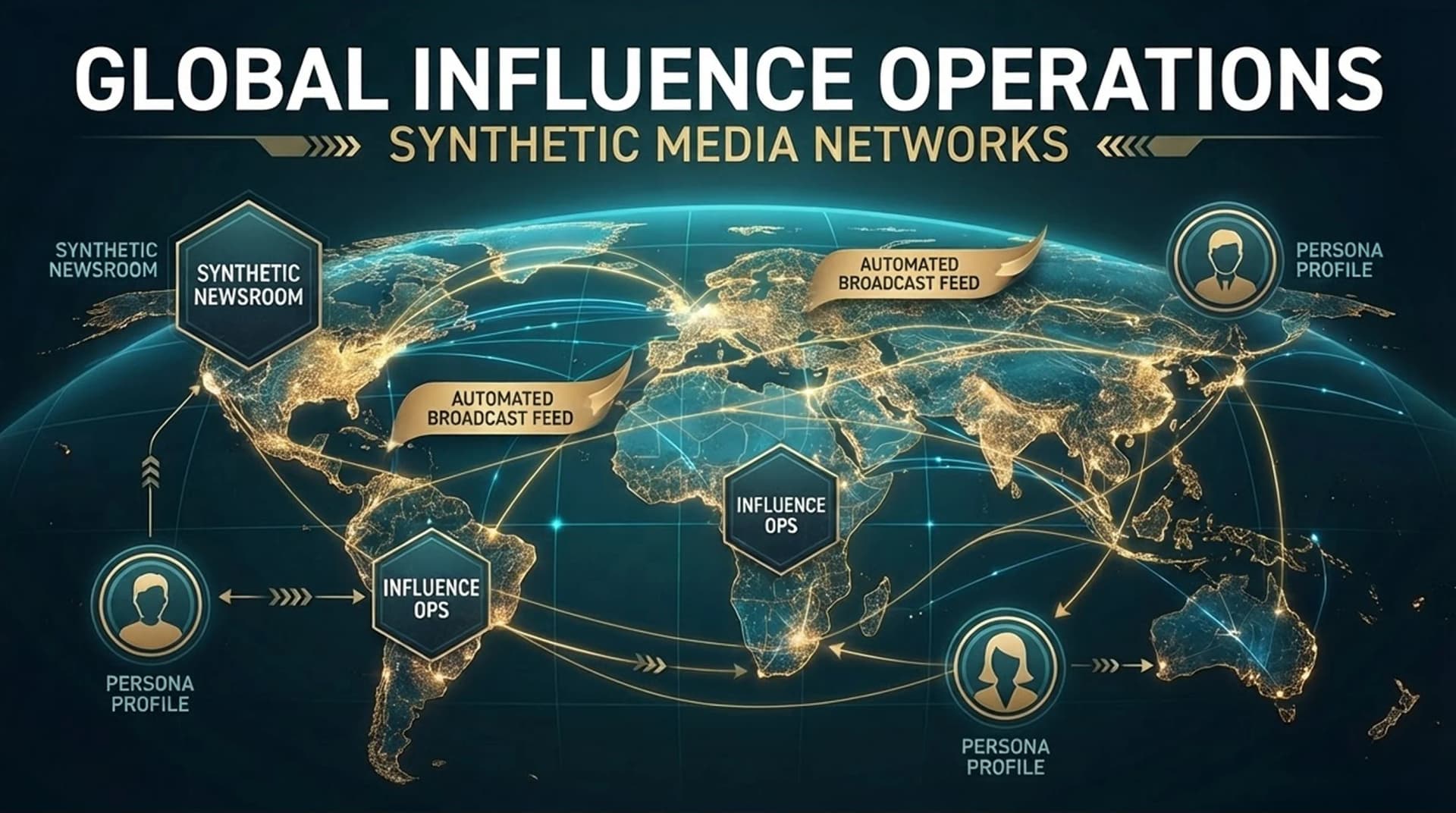
To understand the technical words and acronyms used in this series, please refer to this: A Primer on Terminology
Here, an influence operation means an organised attempt to change what a population believes while hiding who is paying for it. Building one used to require a staff, because somebody had to write the articles, run the fake accounts, keep the story straight across months and fire the people who got it wrong. This section looks at what happened when all of that became the work of one person with a subscription.
Anthropic’s influence-operations disclosure documents nine separate cases. They began in Russia, Iran, Turkey, the Gulf, South Asia, Africa and Europe, and they targeted audiences on six continents. The operators included governments, state propaganda institutions, state broadcasters, commercial firms selling narrative management to paying clients, domestic political operators and one opposition movement in exile.
Two facts about that list matter particularly for Indian readers. First, several operations were not secret state programmes at all. They were products, sold commercially by ordinary companies with offices, clients and invoices; one was being marketed to a national government regulator. Second, the cheapest and most prolific case was run by a single man from a district town in Bangladesh, roughly three hundred kilometres from Kolkata. He used a program he had written himself and rotated 29 accounts to avoid being noticed.
GTG-54002
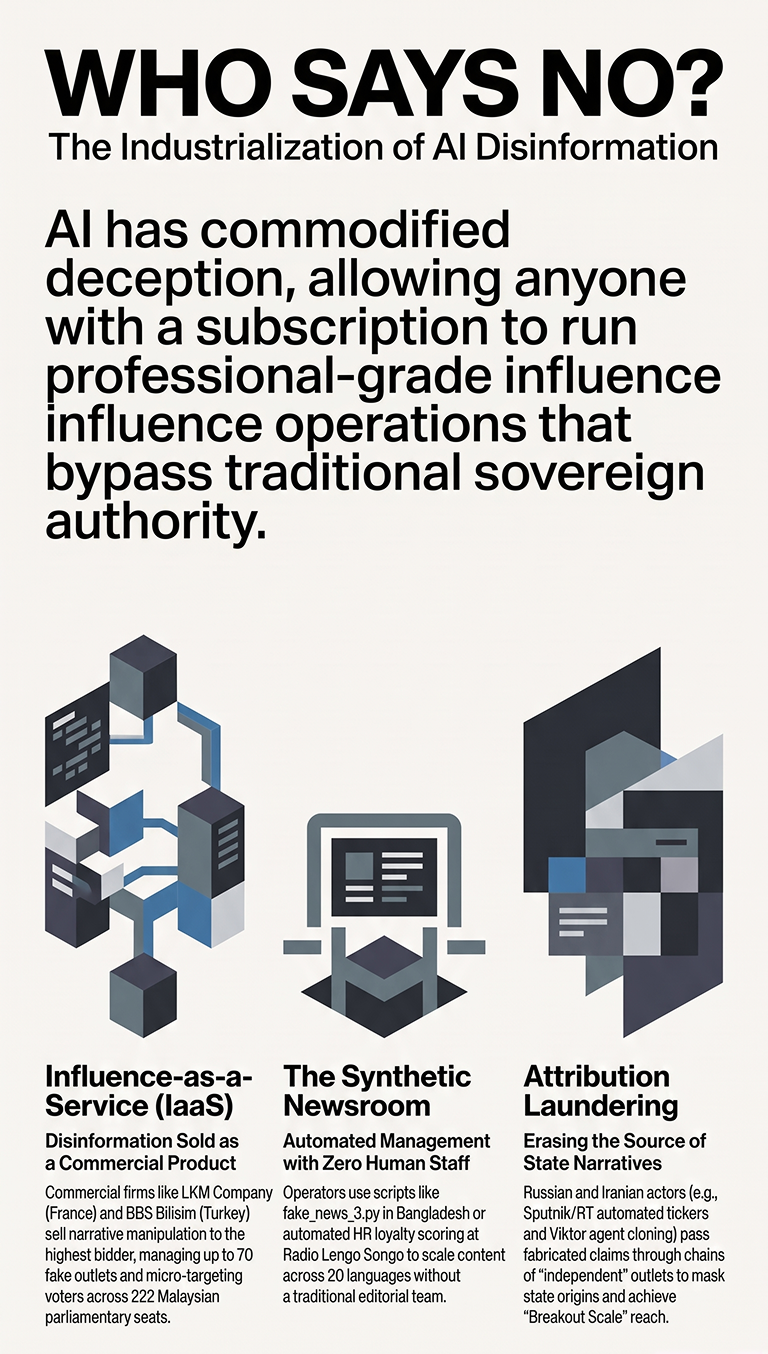
The operation was traced to LKM Company, a France-based digital advertising agency, which ran roughly seventy fabricated news sites amplified by seventy matching X accounts and more than 250 inauthentic commenting accounts using AI-generated profile photos. The network published at least 8,913 articles in about twenty languages. Domains were registered from France inside a ten-week window in mid-2025 and hosted on shared infrastructure behind a single deployment, which is how investigators connected seventy apparently independent outlets to one account.
Every prompt demanded a fixed output structure, formatted HTML, exact character limits, and three to four internal links per article, so publication could be automated and the sites could climb search rankings. Articles carried the bylines of journalists who did not exist.
Three manipulation tactics recurred: rewriting the same source story in opposite ideological directions for different audiences, adding political angles to stories that originally had none, and laundering stories across borders into unrelated regions stripped of context. Coordinated inauthentic behaviour became visible on 11 September 2025, when the network's sites published nearly identical articles about the DRC-Rwanda conflict within three minutes of each other, tone-adjusted per region.
The network had no fixed ideology. It moved across the political spectrum according to whoever was paying at the time. Its outlet roster included a Pakistan-facing property alongside fronts styled for Nigeria, Ethiopia, Kenya, Germany, Britain, Russia, Latin America, China and the United States. The heaviest single focus was the Democratic Republic of Congo, where 318 articles generally supported the government’s position on regional mineral deals and tensions with Rwanda. Anthropic found signals suggesting one or more customers with a stake in that conflict, but it could not confirm who they were and found no evidence of government direction.
GTG-84005
A commercial election-manipulation platform was sold by BBS Bilisim Teknolojileri, an Istanbul-based technology company, as a paid influence-as-a-service product. Publicly, the platform described itself as a defensive cyber-intelligence and counter-disinformation tool. Internally, its own documentation marketed it as a military-grade, AI-driven, real-time political operations system.
It ingested real census and electoral data and built voter profiles across all 222 Malaysian parliamentary constituencies, aimed at what the report identifies as the country's most sensitive faultlines: race, religion and royalty.
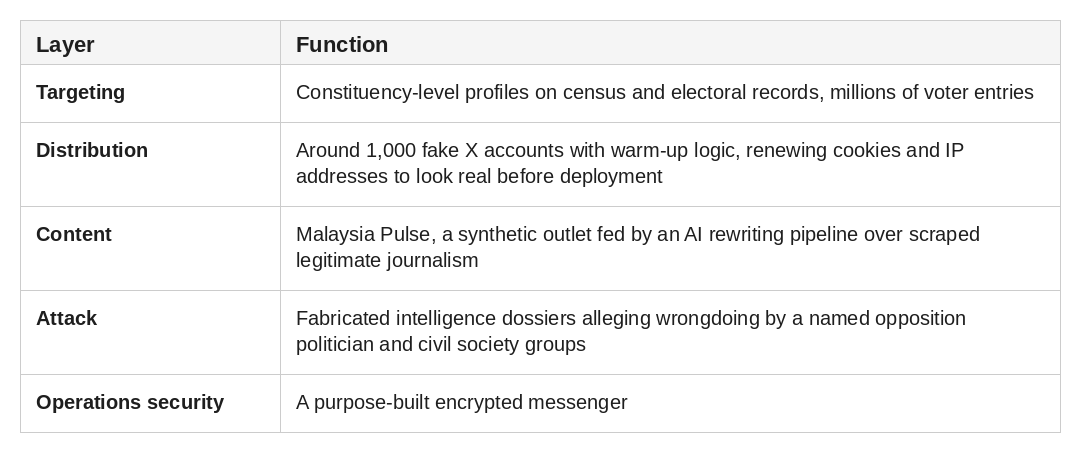
Two details carry most of the significance in this case. The first is sourcing. Malaysia Pulse republished material from Russian and Chinese state-aligned outlets, including TV BRICS, Xinhua, Sputnik, RIA and CGTN, and removed the state attribution so the material read as independent Malaysian reporting. The second is amplification. The management dashboard let operators choose how many artificial views a target should receive. The report records a request, in support of the sitting Prime Minister, for one million artificial views on his account.
The model refused at several points, including once it had identified a fabricated dossier as material for political defamation. The actor negotiated sanitised wording and kept building toward the same capability. The operators also pursued a contract with Malaysia's national communications regulator. Anthropic found no evidence that the pursuit of that contract ever succeeded.
GTG-04001, Central African Republic
A Russian-speaking actor in Bangui providing the production backbone for a Russian state-aligned information manipulation operation. Daily content ran through Radio Lengo Songo on 98.9 FM, coordinated with RT, Sputnik Afrique, TASS and the Russian House in Bangui. An investigation by the All Eyes On Wagner project established that the station was created and funded by the Wagner Group in 2017.
The distribution pipeline is where the innovation sits. The operators traded airtime for slots on SputnikPro, a Russian state media training programme for foreign journalists. That arrangement routed official Russian material onto the national broadcaster under the guise of ordinary programming. Whenever content was generated, the actor explicitly told the model to embed pro-Russia and anti-France talking points and to remove formatting habits that make text read as machine-written.
The operation went on to automate its own human resources function: contracts mandated loyalty to the President of the Central African Republic and to Russia and its contingent. Job descriptions, scoring rubrics and a three-strike dismissal process followed. Staff articles were scored against those criteria, and the model was asked which employees to keep and which to fire. When it flagged the political weighting, the actor relabelled the criteria in neutral terms and kept the scoring.
Alongside this: a recurring surveillance operation tracking opposition figures, talking points drafted for Russian House spokespeople, and forged government documents including Gendarmerie and Ministry of Defence communications, built from original design files. The model refused the most aggressive request, naming real individuals as militants to draw security action against them. Having been refused, the actor switched to an anonymous-source framing and continued.
Rated Category Four on the Breakout Scale, the highest in the report, because it broadcast daily on FM radio and was carried by local outlets.
GTG-24015, Russian state media
Four accounts showed individuals using the model as an editorial desk and sending finished copy straight to production. Output reached Sputnik Moldova and RIA Novosti for Moldovan audiences, Sputnik en Español for Latin America, Sputnik Africa for African publics, and RT’s English-language newsroom for global broadcast.
A former editor-in-chief of Sputnik Moldova turned Romanian and Moldovan news, polling data and opposition social media posts into Russian-language articles, then had them echoed across a network of Russian and Moldovan outlets so the same story appeared independently confirmed. The same actor amplified fabricated defamatory claims about Moldova's president ahead of the parliamentary election of 28 September 2025. A contractor with Russian links produced Latin American Spanish copy under the editorial watch of a Sputnik Mundo presenter, feeding output to a nominally independent Telegram channel that reframed Kremlin-aligned narratives as local commentary. An employee of a Russian state-owned outlet built live broadcast material, tickers, screen captions, voiceover scripts and headlines, from newswire inputs plus material from the SVR and the Defence Ministry. In at least one confirmed instance that material made it onto Russian airwaves.
This is the operation with the widest genuine reach anywhere in the report, and the reason is instructive, because it had no need of a covert network at any point and relied instead on established state media distribution.
GTG-34001, Iranian state institutions
Three accounts tied to named propaganda bodies: the Islamic Culture and Communications Organization under the Ministry of Culture and Islamic Guidance; the Islamic Propaganda Office of Khorasan Razavi, running what the actors called a cognitive warfare command room from a Mashhad seminary; and the Bina Cultural Observatory of the Islamic Propaganda Organization.
All three explicitly tied their work to Iran's state doctrine of Jihad al-Tabyin, explanatory jihad, under which propaganda is framed as both religious and strategic duty. Language drawn directly from that doctrine appeared inside the actors' own sessions and internal planning documents.
The model produced more than content. It helped build institutional apparatus: operating manuals, coded project portfolios, persona systems, early-warning protocols, amplification schedules, target databases and ministerial deliverables carrying official branding. Those deliverables included a nine-part international influence portfolio and complete organisational plans for the funeral and succession of the Supreme Leader. Work ran in Farsi, Arabic, Urdu, Malay, Spanish and English, with a stated plan for twenty languages.
The Mashhad operation ran a multi-province content factory using dozens of activists to repackage Iranian security services' public reporting under personas with no visible link to the state, amplified through paid campaigns across more than a hundred Iranian platform channels. The Bina actor generated messaging in the official voice of an IRGC spokesperson and, during the 2026 US-Israel-Iran war, attributed false claims to Western research institutions including CSIS, Brookings and RAND. The network also produced counter-narrative content targeting the Bahá'í, a persecuted religious minority, and target databases naming international officials and opposition figures.
Access from inside Iran is blocked, so the operators used VPNs and foreign phone numbers. They then repeatedly named their own locations, institutions and roles in conversation, which is largely how the attribution was made.
GTG-84002, United Arab Emirates
One actor is running a sustained operation against the Muslim Brotherhood through an AI persona called Deadshot on a private platform, with a master doctrine file instructing the model to repeat the same mission across hundreds of sessions.
The work had five synchronised lines. One was a group of roughly 300 centrally funded influencer accounts whose supposed independence internal reporting called the operation’s greatest asset. A second was a front NGO that copied a real Swiss organisation’s identity to publish state-authored human rights reports. A third was ghost-written testimony for two named individuals at the 62nd session of the UN Human Rights Council, with explicit instructions not to mention the UAE. A fourth was research on eighteen members of the European Parliament and prominent journalists. The fifth was a set of counter-accountability dossiers on UN Special Rapporteurs who had criticised UAE conduct in Sudan.
Attribution to UAE government officials is made with high confidence, partly because the doctrine file named senior officials as the intended recipients.
GTG-54006, Bangladesh
A single actor in Gaibandha District rotated 29 accounts to evade limits. He ran a script, iterated at least to a third version, that generated fixed batches of fifteen Bengali headlines, three fabricated narratives and fifteen image prompts per run. Before disruption, the operation had produced at least 1,500 headlines, 300 false narratives and 1,500 prompts. A companion uploader published to YouTube on a schedule set a month ahead, routed through a third-party continuous integration service to mask the operator’s address.
Content was uniformly pro-Awami League, attacking the BNP, Jamaat-e-Islami, the National Citizens Committee, the interim government and student protest leaders, mainly through fabricated foreign-agent smears, invented assassination plots, and claims the opposition planned Taliban-style rule. It was calibrated for rural, lower-literacy audiences feeding a continuous cycle of Facebook Live, YouTube and TikTok streams. The actor's own notes acknowledged the audience believed it was real news. Because the Awami League has been out of power since the July 2024 uprising, this was an opposition operation, not a government one.
Anthropic records, with a caveat that should be carried forward intact, that some of the network's narratives also aligned with pro-Indian geopolitical interests, while stating it found no evidence of state direction or funding behind the activity. That is a finding about narrative alignment, not sponsorship, and accurate reporting of that distinction is nowhere in this series as important as it is here.
GTG-54004, Kenya
One actor generated batches of exactly fifty tweets, explicitly instructed to make them look like spontaneous grassroots commentary. Much of it praised the Energy Cabinet Secretary for stopping an electricity tariff rise, using dedicated hashtags. The rest pushed claims that the United Opposition coalition was collapsing ahead of the 2027 general election, targeting named politicians.
The detail that makes this case travel: the same actor ran the identical workflow for Kenyan retail brands under a marketing persona, including a promotional broadcast repackaged as organic tweets with links inserted on every fifth post. The report notes this fits a known local pattern of agencies paying influencers to shape narratives. The operation was rated Category One, meaning that it reached nobody real at any point, and it came to light through a tip from OpenAI about a repeat offender on their own platform.
GTG-84006, MEK and NCRI-aligned
An exile opposition network, not an Iranian state operation, and the distinction matters. The operators cloned a real activist's personal Telegram account, had the model read roughly 8,400 of his posts to copy his style, then told it in Persian that it was now that person and used it to run live political conversations with his contacts inside Iran. To Anthropic's knowledge, none of those contacts understood that they were speaking to an AI-assisted account.
The network scraped more than 500 social media channels to profile individuals inside Iran. It grouped people by city, age, occupation, political alignment and arrest history, then analysed roughly 51,944 archived messages to build psychographic dossiers on dozens of named people. The impersonation accounts sent a fabricated breaking-news headline to more than thirty contacts at once. AI-generated avatars were animated, given Persian audio and styled to look like ordinary Iranians while their synthetic origin was deliberately concealed. Everything ran on a shared agent platform named Viktor, with long-term memory files holding banned-word lists, approved sources, account rules and evasion techniques, so the system could keep producing without a human directing each session.
The output swapped the organic 2022 protest slogan Woman, Life, Freedom for the organisation's variant, Woman, Resistance, Freedom. Arrest-history profiling of people who face imprisonment or execution under Iranian law is the most serious element in the case.
Six patterns run across all nine cases, and each of them is a life condition in India instead of a foreign curiosity.
Influence is sold as a service
In two cases a working advertising or marketing firm ran the operation alongside ordinary commercial work. This gives the ultimate commissioner deniability and puts the capability within reach of anyone who can pay.
The model was slotted in as a sub-editor
In several cases it joined a human-edited pipeline that was already running, which is what let thinly resourced actors operate far beyond their own capacity.
It built the apparatus, not just the content
The inventory runs to doctrine manuals, opposition dossiers, ministerial portfolios, persona systems, target databases, employment contracts encoding editorial loyalty and staff scoring rubrics, all of which is work that would otherwise have required a staffed programme office of real size to produce and maintain.
Operations now live in memory files, not prompts
Operations now live in reusable files, not one-off prompts. Actors reused markdown doctrine almost word for word across hundreds of sessions, kept shared files of approved sources and evasion rules, and used custom software to call the model in fixed batches. One central setup meant the people producing content did not need to coordinate with, or even know, one another. One actor was building a course to teach the workflow to others.
Attribution laundering is a feature
Actors asked the model to remove the tell-tale signs of machine-written text, to sound like a person, and to pass claims through a chain of separate outlets so that the final version appeared to have been confirmed by several independent sources when all of it came from one. In one Russian state media case, an actor produced claims the model flagged as unverified, then instructed it to drop the caveats so the material would read as established fact.
Most of it reached nobody
Because the company sits at the production stage, upstream of the platforms themselves, it often catches operations while they are still being assembled, which is why most of the content it found had drawn little or no authentic engagement from real audiences. The widest genuine reach anywhere in this section came through state media distribution, meaning FM radio, satellite, shortwave and global television, and not through any covert network.
That last point cuts both ways, because the operations that succeed are by definition the ones an AI provider never sees at all.